Whale watching from Tromsø in winter
The whales feed far north of the city, in the dark weeks of the year. How the herring decides the season, how a whale day is put together, and how to choose the boat that suits you.
Whale watching from Tromsø happens a long way from Tromsø. Since 2017, orcas and humpback whales have gathered in winter in the Kvænangen area, including the fjords around Skjervøy, about 160 km from the city by road. They come for one reason, the herring, and that single fact explains most of what you need to plan: the season, the length of the day, and why no one can promise you a sighting.
Why the whales come to Skjervøy
The herring currently spends the winter, from November to February, in the coastal waters of Troms. According to Store norske leksikon, large groups of orcas gather wherever it does, and the herring's movements shape much of the orcas' life in the north. A herring-eating orca needs around 50–60 kilos of fish a day. Humpback whales live mainly on krill but also eat herring and capelin. In winter the species is best known from its breeding grounds in the Caribbean, yet humpbacks often come right into the fjords here at that time of year.
The herring does not always choose the same fjord. Visit Tromsø points out that it can move to different areas from year to year, and the whales go with it. Tour boats from Tromsø therefore head to wherever the fish are that day, and the length of the trip follows.
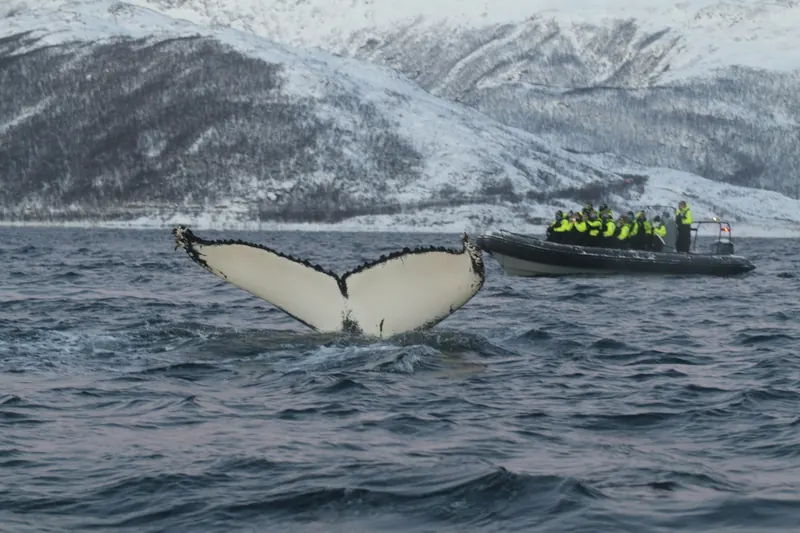
The two species are easy to tell apart. An adult male orca can be about nine metres long, with a straight, triangular dorsal fin of up to two metres. Females are around 7.5 metres and have a smaller, curved fin. A humpback reaches 16–17 metres and lifts its tail fluke above the water when it dives. The pattern on the underside of that fluke is different for each animal, so it can be used to recognise individual whales.
Which weeks to pick
The season usually runs from about mid-October to the end of January, with the exact timing changing from year to year. For 2026/27 the hybrid-electric catamaran in our list has dates from 14 October to 31 January. Visit Tromsø names early November to the end of January as the core of the season. Towards the end, a whale trip can turn into a fjord cruise: the hybrid-electric catamaran in our list offers a fjord route with a partial refund, or a cancellation, once the whales have left.
Light is the second thing to think about. Skjervøy lies further north than Tromsø, so its polar night is slightly longer. MET Norway's data for a flat horizon put the last sunrise there on 25 November 2026 and the next one on 17 January 2027.
| Date | Sunrise | Sunset |
|---|---|---|
| 1 November 2026 | 08:06 | 14:31 |
| 20 November 2026 | 10:03 | 12:39 |
| 26 November 2026 to 16 January 2027 | Polar night, sun below the horizon | |
| 17 January 2027 | 11:28 | 12:04 |
| 31 January 2027 | 09:29 | 14:10 |
Even on 21 December there is civil twilight at Skjervøy from 09:31 to 13:37, around four hours of blue and pink light. The bus that leaves Tromsø at 05:00 needs about four hours to Skjervøy, so the time at sea falls into this window. In early November you still get several hours of real daylight for photos. In December you are watching whales in twilight.
Two ways to reach the whales
Visit Tromsø describes the two options: a return boat trip from Tromsø, or a bus or minibus to Skjervøy combined with a boat trip from there. Both normally take the whole day.
By boat from Tromsø, you sit in a heated lounge for most of the journey. The trips in our list take 7–9 hours, with roughly 1–2.5 hours in the whale area depending on the boat and where the herring is. The heated ship in our list leaves the Front Pier at 08:00, so the day starts without a pre-dawn bus.
With the bus, the day starts at 05:00 and takes about 12 hours, around four of them on the road in each direction. In return you spend about three hours on the water in a small boat that is launched right at the whale grounds.
A third way is to travel to Skjervøy yourself and stay a night or two. Without a car, the options are Svipper's express boat Line 3 (about 2–3 hours, daily except Saturdays) and a direct bus that only runs in the whale season, from late October or early November through January. Trips from the harbour in Skjervøy take about four hours, which leaves a spare morning for a second try if the first day brings no whales. Our page on day trips from Tromsø has the road route with its two ferries.
Which boat suits whom
The big catamarans and the heated ship are the easy option. You can go inside to warm up whenever you like, and some include lunch while others sell food on board. They suit families and anyone who worries about the cold, with one restriction to note: the heated ship in our list does not take guests over 70.
An open RIB puts you low on the water and close to the animals, but it is fast, exposed and bumpy. The RIB trips here have a minimum age of 14 and a minimum height of 140 cm, and they are not suitable during pregnancy or for people with back problems. One operator also advises against the trip if you get seasick easily or have low fitness. Space on board is tight, so large bags stay on land.
A boat with a heated cabin from Skjervøy sits in between: you are close to the whale grounds from the start, and you can still step inside between sightings.

What to wear on the water
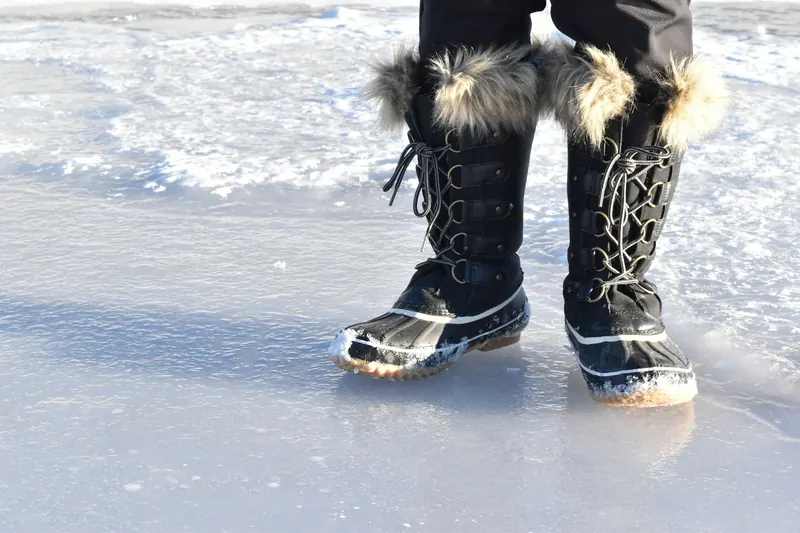
Visit Tromsø's packing list for whale trips is short: warm clothes, winter boots, a woollen hat and mittens. For trips out of town it suggests preparing for anything from −25 °C to +5 °C, and dressing in layers with wool next to the skin. One RIB operator warns that it gets very cold on the water in a fast, open boat.
On RIB trips the operator provides a thermal or flotation suit, boots and goggles, and some also hand out gloves and socks. You still need your own warm layers underneath. On the catamarans and the heated ship, check the tour details for what is provided, and bring enough warm layers for the time you spend on the outside decks. Our winter clothing guide lists what to pack in more detail.
Seasickness and weather
The open-water stretches can be rough. Brim Explorer warns about the sea state in its own tour description, and one RIB operator lists people prone to seasickness among those who should not join. If you are unsure, take seasickness precautions before you board. When the weather makes the whale grounds unreachable, the hybrid catamaran sails a fjord route instead, so read the cancellation terms of your tour before you book.
It also helps to bring your own food. Some trips include lunch or snacks, others sell food on board, and the operator of the early RIB day recommends packing your own for the long bus ride.
Distance rules for whale boats
Norway has had a regulation on whale safaris since 2019. It bans whale safaris that disturb the whales in their natural habitat, and it counts swimming, diving and paddling as whale safari too. Boats must keep at least 370 metres from vessels that are fishing, and swimmers, divers and paddlers at least 740 metres from them.
The detailed rules on the water are voluntary. Guidelines from 2017, written by Visit Tromsø with researchers from UiT, advise at most three boats with a group of whales, at most 30 minutes per boat, a speed below five knots within 300 metres, and idle speed from 50 metres. Boats should move parallel to the whales and never try to attract or touch them. These guidelines are not legally binding. In observations from 23 October 2025 to 15 January 2026, an average of 9 to 14 boats were around the same group of whales, and 8 out of 10 boats were closer than 100 metres. Several operators and Visit Tromsø have asked the authorities for a licensing scheme, a speed limit in whale areas and a ban on snorkelling close to the whales.
Fitting a whale day into your trip
A whale trip fills a whole day, so plan it on its own date and keep the day after flexible in case the weather cancels the boat. If you go in the polar night, the city is dark long before you return, and the northern lights are often most active between about 20:00 and 02:00. After the RIB day, which ends back in Tromsø at around 17:30, an aurora tour the same evening is possible but tiring. You may do better with a quiet evening and the northern lights on another night.
The rest of the stay fits around it. Husky trips need snow, which near the coast can still be thin in November, while a calm daytime fjord cruise from the city centre works without snow and gives you the fjord landscape without the long journey north.

Whale trips from Tromsø and Skjervøy, with boat sizes, departure points and time at sea side by side, are compared on tromso-whalewatching.com.
Whale trips for the 2026/27 season
Boats from the harbour in Tromsø first, then the trips that start at Skjervøy, with or without a bus from the city.
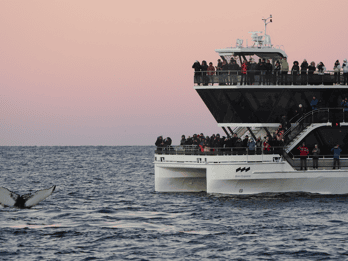
Whale watching · Brim Explorer
Whale watching on a hybrid-electric catamaran
The big hybrid-electric catamaran with heated panorama lounges. On days when the weather rules out the whale grounds, it sails a fjord route instead.
- Duration 7–9 hours
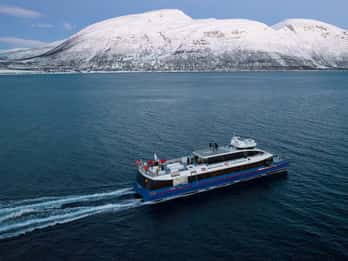
Whale watching · Arctic Resorts
Whale watching by high-speed catamaran
About 2.5 hours in the whale area, guiding also in German, and a second chance if no whales are sighted.
- Duration 8 hours
- Meeting point Rødne quay, city centre
- ✓ Free cancellation

Whale watching · Polar Adventures
Whale cruise on a heated ship with lunch
Leaves the Front Pier at 08:00 with at most 50 passengers and lunch on board. Not open to guests over 70.
- Duration 8 hours
- Meeting point Front Pier, Tromsø, 08:00
- ✓ Free cancellation
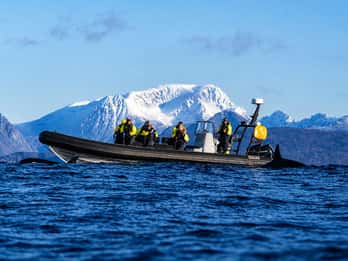
Whale watching · Arctic Adventure Tours AS
RIB whale safari from Skjervøy
Built around time close to the whales: the bus leaves at 05:00 and you spend about three hours in an open RIB from Skjervøy.
- Duration About 12 hours
- Meeting point Scandic Ishavshotel, 05:00
- ✓ Free cancellation
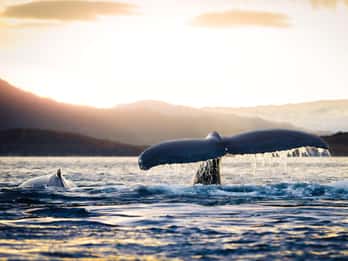
Whale watching · Frozen Frontiers
Open RIB whale trip from Skjervøy, bus from Tromsø optional
The same kind of open RIB, bookable from the harbour in Skjervøy or with a bus from Tromsø, followed by a hot drink and a sandwich on land.
- Duration About 4 hours from Skjervøy, about 12 hours with the bus
- Meeting point Skjervøy harbour, or bus from Tromsø (details after booking)
- ✓ Free cancellation
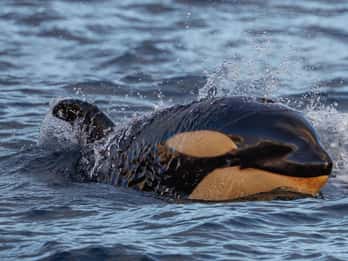
Whale watching · Dervola Adventure AS
Whale trip from Skjervøy in a boat with a heated cabin
A good choice if you stay in Skjervøy: a boat with a heated cabin, 09:30 to about 14:00, and a hydrophone when conditions allow.
- Duration 4 hours, 09:30 to about 14:00
- Meeting point Havnegata 16, Skjervøy (marina)
- ✓ Free cancellation
Prices and ratings in these cards come straight from the booking platform and are shown in euros per person. If you book through them we earn a commission, and your price stays the same.
Questions travellers ask
Are whale sightings guaranteed?
No. Visit Tromsø says sightings cannot be guaranteed, because the whales follow the herring and the herring can move. One of the catamaran trips on this page offers a second trip on days without whales. Plan a spare day if seeing whales matters a lot to you.
Can I go whale watching in October or February?
From about mid-October, yes. For 2026/27 the hybrid-electric catamaran on this page has dates from 14 October to 31 January and none in February. Visit Tromsø names early November to the end of January as the main season, and the herring stays in the coastal waters of Troms from November to February. In the first and last weeks the timing is less predictable, and towards the end of the season the whales may already have left.
Is a catamaran or a RIB better?
A catamaran or heated ship leaves from Tromsø, has warm indoor seating and suits families and anyone who feels the cold. A RIB is a small open boat that starts at Skjervøy, gives you about three hours close to the water and needs a reasonable level of fitness. The RIB trips on this page have a minimum age of 14 and a minimum height of 140 cm.
Can I see the northern lights on the same day?
Sometimes. The open RIB day with the bus from Tromsø is back in town at around 17:30, and the northern lights are often most active between about 20:00 and 02:00. After a day that started at 05:00, you may prefer to keep the evening free and book the aurora for another night.
Can I swim or snorkel with the whales?
The voluntary guidelines from Visit Tromsø discourage in-water activities with whales, and Norwegian rules require that whale safaris do not disturb the animals. Several tour operators have also asked the authorities to ban snorkelling close to whales.
Where these facts come from
Dates, opening hours and rules change. We checked these pages in October 2026; the official source has the final word.
- Visit Tromsø: Whale watching
- Visit Tromsø: Whale watching guidelines
- Visit Tromsø: Whale watching calls for stricter rules
- Regjeringen: Forskrift om utøvelse av hvalsafari (2019)
- Visit Tromsø: How to travel between Tromsø and Skjervøy
- Visit Tromsø: Express boat and ferries
- Store norske leksikon: Spekkhogger
- Store norske leksikon: Knølhval
- MET Norway: Sunrise API
- Visit Tromsø: When and where to see the northern lights
- Visit Tromsø: How to dress in the Arctic